

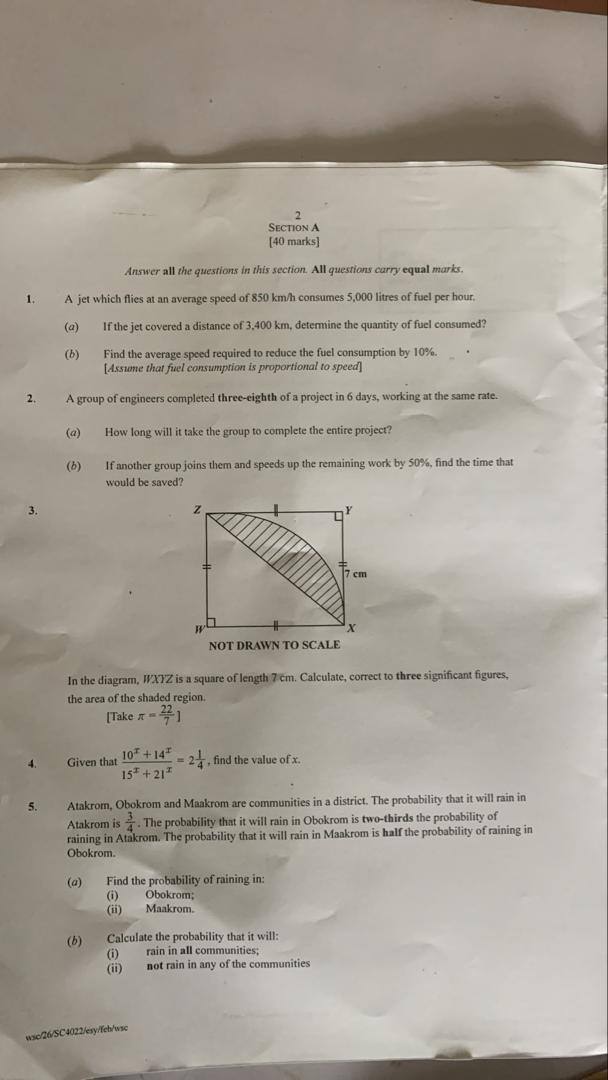
Growing up mathematics is one of those subjects that can make a student feel less confident and completely make student dislike school. For some students, numbers, formulas and equations seem easy. For others, mathematics becomes a source of frustration, especially when they repeatedly get answers wrong despite studying hard but being good at mathematics is not simply about being “a math person.”
Mathematics is a skill that can be developed through understanding, regular practice, patience and problem-solving. Ghana’s mathematics curriculum places emphasis on reasoning, problem-solving, critical thinking and applying mathematical knowledge to real-life situations. NaCCA’s mathematics curriculum also identifies areas including numbers and algebra, measurement and geometry, and statistics and probability.
So, whether you are preparing for BECE, WASSCE, school examinations or simply want to become more confident with numbers, here are practical ways to improve your mathematics skills.
1. Stop Believing That You Are “Bad at Mathematics”
One of the first things you need to change is your mindset.
Statements such as I am not good at math, mathematics is too difficult for me, I will never understand algebra, can gradually become self-fulfilling beliefs but making mistakes does not mean you cannot learn mathematics. It means there is something you haven’t understood yet. Instead of saying “I can’t do this,” ask “What part of this problem don’t I understand?” That small change can make you approach difficult questions differently.
2. Build a Strong Foundation
Many students struggle with advanced or add mathematics because they have gaps in basic concepts. For example, if you are struggling with algebra, your problem may actually involve fractions, negative numbers, multiplication or basic arithmetic. Go back and identify the areas you don’t understand. Make sure you are comfortable with fundamentals such as:
- Addition and subtraction
- Multiplication and division
- Fractions
- Decimals
- Percentages
- Ratios
- Negative numbers
- Basic algebra
- Measurement
- Basic geometry
A strong foundation makes more advanced topics easier to understand.
3. Understand the Method, Not Just the Answer
One of the biggest mistakes students make is memorising answers without understanding how they were obtained. Suppose a teacher solves a mathematics problem on the board, and you copy the final answer. You may remember the answer today, but what happens when the examination gives you a slightly different question? Understanding the method gives you the ability to solve new problems. Whenever you see a solution, ask:
- Why was this step taken?
- Where did this number come from?
- Why was this formula used?
- Could there be another way to solve it?
Mathematics becomes much easier when you understand the reasoning behind the steps.
4. Practise Mathematics Every Day
When I was helping my cousin in Kasoa sometime ago for BECE 2025, he failed math because he tried to solve 50 questions in one night. What worked was this: We picked just ONE question from the 2019 BECE e.g., “Find the LCM of 12 and 18” and spent 30 minutes understanding why the answer is 36, not just copying the answer. Do this daily. By the time you sit for your BECE, you would have solved 90 real BECE questions, and that is more than enough to better your grade in the final examines.
5. Solve Problems Yourself Before Looking at the Solution
When you encounter a difficult question, don’t immediately search for the answer. Give yourself time to attempt it and write down what you know. Identify what the question is asking and choose a possible method. Work through the steps. Even if your final answer is wrong, the attempt itself helps you identify where your understanding breaks down. Then compare your work with the correct solution.
6. Keep a Mathematics Mistake Book
This is one of the simplest ways to improve,
- create a notebook specifically for your mistakes.
- Whenever you get a question wrong, record:
- The question
- Your answer
- The correct answer
- Where you went wrong
- The correct method
For example: Topic: Percentages
Mistake: I calculated 20% of 500 as 50.
Correction: 20% = 20/100, so 20% of 500 = 100.
Review your mistake book regularly. Your repeated mistakes can reveal the areas that need the most attention.
7. Learn Your Formulas Properly
Formulas are important in many areas of mathematics but don’t simply memorise them without understanding what they represent. For example, if you are learning the area of a rectangle: Area = length × width, understand what the length and width represent and how the formula applies to real objects. When you understand a formula, remembering and applying it becomes easier. Also learn when a formula should not be used.
8. Practise Word Problems
Many students can solve straightforward calculations but struggle when the same mathematics is presented as a story. This is why word problems deserve special attention. When you see a word problem:
Step 1: Read it carefully, don’t rush.
Step 2: Identify what you know, write down the information provided.
Step 3: Identify what you need to find, what exactly is the question asking?
Step 4: Choose the appropriate method, decide which mathematical operation, formula or concept applies.
Step 5: Solve the problem, show your working clearly.
Step 6: Check your answer, ask yourself whether the answer makes sense, this process can make complicated-looking questions much easier.
9. Learn From Your Teacher
Don’t underestimate the value of asking your mathematics teacher questions. If you don’t understand something, ask. You can say: “Please, can you explain this step again?” or “Why did we use this formula?” A good teacher can identify misunderstandings that you may not notice yourself. Don’t wait until examination week before asking about topics you have struggled with for months.
10. Study With Other Students
A serious study partner or study group can help you understand mathematics from a different perspective. Sometimes another student can explain a concept in a way that makes more sense to you than the original explanation. You can take turns solving questions and explaining your methods and teaching someone else can also expose gaps in your own understanding. However, keep the group focused. If the session becomes mostly conversation and entertainment, it is no longer serving its purpose.
11. Use Your Phone as a Mathematics Learning Tool
Your smartphone can be more than a social media device. You can use it to:
- Watch mathematics lessons.
- Access digital textbooks.
- Set study reminders.
- Use educational applications.
- Find additional explanations.
- Take photographs of classroom notes.
- Create flashcards.
- Practise questions.
Ghana’s current curriculum also recognises the role of digital technology in mathematics learning and encourages learners to use mathematical tools and technology appropriately. However, don’t allow your phone to become a distraction. If you are studying from your phone, activate Do Not Disturb or Focus Mode and use only the resources you need. You can read more on how to use phone effectively to study.
12. Use AI to Explain, Not to Think for You
AI tools can be useful when you are stuck on a mathematical concept. You can ask an AI tutor to explain a problem step by step, give you similar questions or explain a concept using simpler examples but avoid simply entering every homework question and copying the answer. If you do that, you may complete the exercise without developing the skill. A better approach is:
Try → Get stuck → Ask for guidance → Understand → Try again independently. The objective is to make your brain stronger at solving mathematical problems.
13. Practise Without a Calculator Sometimes
Calculators are useful tools, but you should also develop mental and written calculation skills where your course or examination requires them. Practise simple calculations mentally. For example:
- 15 × 4
- 250 ÷ 5
- 10% of 500
- ¾ of 80
- 125 + 275
Mental calculation helps you develop number sense and can make more complicated calculations easier. For examinations, always follow the specific rules about whether calculators are permitted.
14. Learn to Check Your Answers
Getting an answer is not always the end of the problem. Learn to check your work. For example, if you calculate the cost of five items as GH¢5,000, ask yourself: does that answer make sense? If each item costs approximately GH¢100, something has obviously gone wrong. Checking your work can help you catch:
- Calculation errors
- Wrong signs
- Incorrect units
- Transposed numbers
- Wrong formulas
- Misread questions
Develop the habit of asking, “Does my answer make sense?”
15. Practise Past Examination Questions
If you are preparing for BECE or WASSCE, past examination questions should form part of your preparation. The West African Examinations Council (WAEC) provides examination guidelines and structures for candidates, while NaCCA also provides mathematics assessment resources for learners preparing for the Junior High School exit examination. Don’t just solve questions randomly but use them to identify patterns in your own weaknesses. If you consistently struggle with algebra, spend more time on algebra. If geometry is your weakness, practise more geometry. Your revision should respond to your mistakes.
A Simple 7-Day Mathematics Improvement Plan
If you want to start immediately, try this:
Day 1: Identify your weakest mathematics topics.
Day 2: Revise the basic concepts behind your weakest topic.
Day 3: Solve 10–20 practice questions.
Day 4: Review your mistakes.
Day 5: Solve more difficult questions.
Day 6: Attempt mixed questions without looking at your notes.
Day 7: Review everything you struggled with during the week.
Then repeat the cycle with another topic.
Mathematics Is a Skill, Not a Talent Contest
Some students may understand mathematics quickly while others need more time. That doesn’t mean the second group cannot become excellent at it.
The ability to solve mathematical problems develops through practice, reasoning and perseverance. This aligns with Ghana’s mathematics curriculum, which explicitly encourages learners to develop mathematical curiosity, reasoning, critical thinking and perseverance when solving problems.
You don’t have to understand everything on your first attempt. You need to keep asking questions, practising and learning from your mistakes.
The student who solves five mathematics questions every day may eventually outperform the student who only studies mathematics when an examination is approaching. So, if mathematics has been difficult for you, don’t give up.
Start small. Practise consistently. Understand your mistakes. Ask for help. Then try again. Your goal should not be to become perfect at mathematics overnight. Your goal should be to become better than you were yesterday.
Sources:
Students and teachers in Ghana can consult NaCCA’s official mathematics curriculum resources
https://nacca.gov.gh/secondary-education-curriculum/?utm_source=chatgpt.com and WAEC Ghana’s examination guidelines https://waecgh.org/bece-guidelines-scheme-and-structure/?utm_source=chatgpt.com for official curriculum and examination information.