

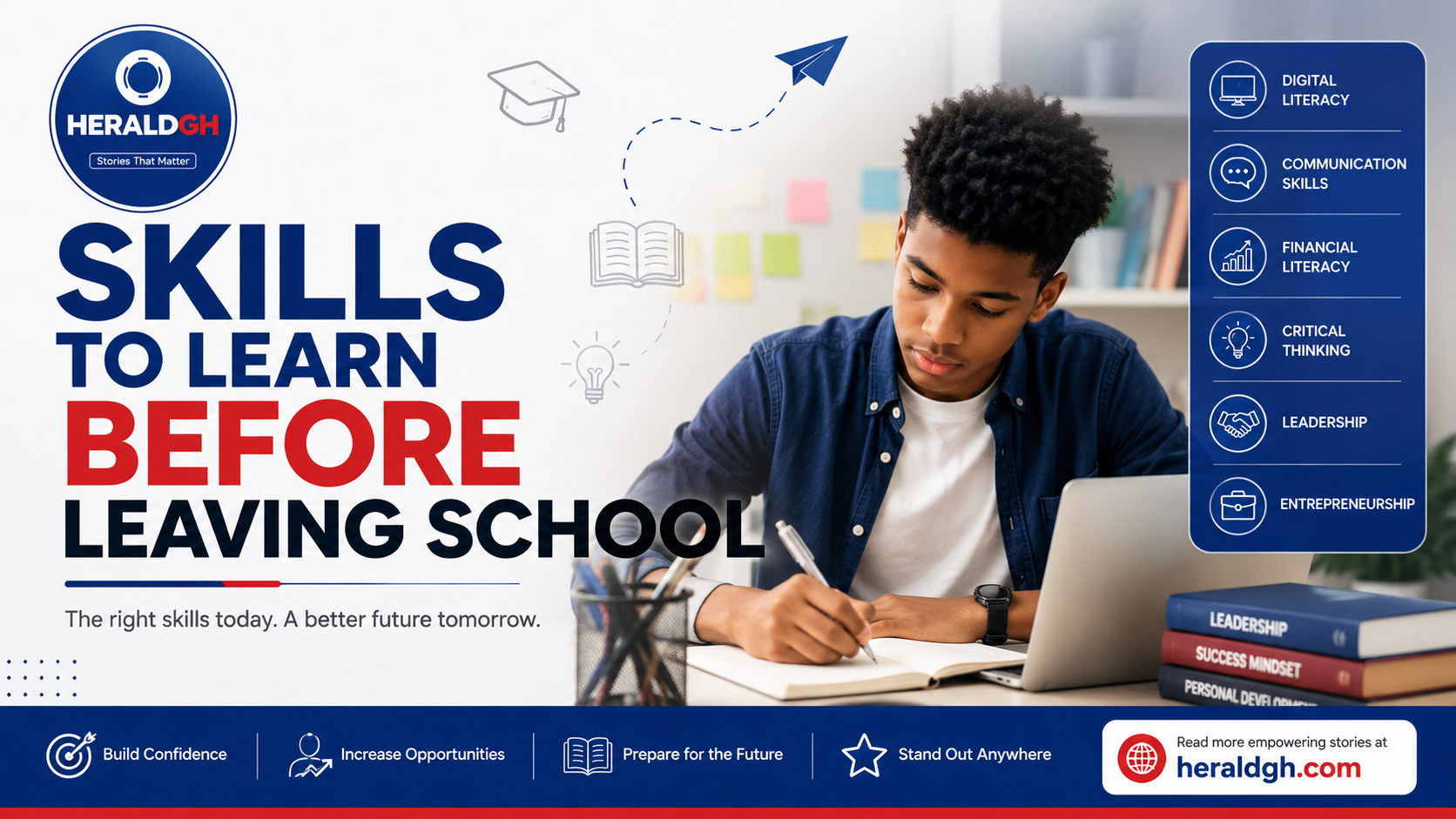
Many schools both the private and public schools are only focused on how to make students to obtain good grades without thinking about how they will navigate life after school. Certificates are good but you can’t go through a school system only to acquire a certificate.
For many Ghanaian students, the real life begins after graduation. Suddenly, they are expected to find work, manage money, communicate professionally, make important decisions and compete in an increasingly digital economy.
But there is one question many are afraid to ask;
Are our students learning enough skills to prepare them for life beyond the classroom?
Many students are equipped on how to answer examinable questions to pass exams with good grades but lack the skills on how communicate, respond to interview questions, write good email, manage their finances or identify genuine opportunities online.
That is why students need to develop practical skills alongside their academic education.
Here are some skills every Ghanaian student must learn before leaving school;
1. Communication skills
The ability to communicate clearly is useful in almost every career of our life
Students should learn how to express their ideas confidently, listen to others, write professionally and communicate respectfully without feeling shy or intimidated.
Good communication can make a difference during job interviews, presentations, business negotiations and everyday interactions.
Being knowledgeable is valuable but knowing how to communicate that knowledge is equally important.
2. Financial literacy
One of the major skill our school system has failed many generations is not teaching about finance or how to manage money. Student must be thought the following;
- Saving
- Budgeting
- Responsible borrowing
- Interest
- Investing
- Emergency funds
- Distinguishing needs from wants
A young person who earns money without knowing how to manage it can easily find themselves in financial difficulty.
Financial education should therefore begin before a student starts earning a full-time income.
3. Digital Skills
Technology is now part of almost every industry.
Students don’t necessarily need to become programmers, but they should be comfortable using technology productively.
Useful digital skills that students must learn include:
- Microsoft Office or Google Workspace
- Online research
- Email communication
- Basic graphic design
- Social media management
- Digital marketing
- Video editing
- Artificial intelligence tools
- Online collaboration
These skills can provide opportunities in many ways if they didn’t find themselves in their prospective career path.
4. Critical Thinking
The internet has made information easier to access but not all information is accurate.
Students need to learn how to question information, examine evidence, identify misleading claims and make decisions based on facts rather than rumors.
Critical thinking is particularly important in an age where social media can spread false information within seconds.
5. Public Speaking
Many talented young people struggle to express ideas or themselves in front of others.
Learning public speaking can improve confidence and help students perform better during presentations, interviews, meetings and professional events.
Students can begin by participating in debates, presentations, school clubs and group discussions.
6. Problem Solving
Employers and businesses need people who can solve problems rather than simply identify them.
Students should learn to look at challenges from different perspective, identify possible solutions and evaluate the consequences of each option.
Problem-solving is useful whether you eventually become an engineer, teacher, entrepreneur, designer, technician or professional in any field.
7. Basic Entrepreneur
Not every student will become an entrepreneur but understanding basic things about how business is run can be useful.
Students should understand basic concepts such as:
- Identifying a problem
- Creating a product or service
- Finding customers
- Pricing
- Marketing
- Keeping records
- Managing expenses
Entrepreneurship education can also help students recognize opportunities around them.
8. Negotiation Skills
Negotiation skills is an underrated skill that each and every one must have for personal life.
People negotiate every day during business transactions, employment discussions, purchases and partnerships.
Learning how to communicate your value, listen to the other person’s position and reach a fair agreement can become a powerful life skill.
9. Time Management
Students often have multiple responsibilities competing for their attention.
Learning how to prioritise tasks, set deadlines and avoid unnecessary distractions can improve both academic and professional performance.
One of the most valuable lessons is that being busy does not necessarily mean being productive.
10. Practical Skill
Every student should consider learning at least one practical or vocational skill which can serve as self-employment
This could include:
- Electrical work
- Plumbing
- Carpentry
- Fashion design
- Photography
- Catering
- Hairdressing
- Automotive work
- Cleaning services
- Graphic design
Having a practical skill can provide an additional source of income and may become a full-time career.
11. Networking
Many opportunities come through relationships.
Students should learn how to introduce themselves, maintain professional relationships and connect with people who can contribute to their development.
Networking does not mean knowing influential people simply for personal gain. It means building genuine relationships and learning from others.
12. Researching skills
Some student complete various levels of education cycle without knowing how to source for right information from internet or other avenues. Students should know how to find reliable information rather than depending entirely on what friends or social media say.
Good research involves identifying credible sources, comparing information and checking when and where information was published.
This skill becomes increasingly important when making decisions about education, employment, business and personal finance.
13. Adaptability
The world of work is constantly changing.
Some jobs that exist today may look very different in the future, while new careers will continue to emerge.
Students should therefore develop the ability to learn, unlearn, relearn and adapt.
Instead of asking only, “What job can I get with this certificate?” young people should also ask, “What skills can I continue developing throughout my career?”
14. Self-Awareness
One of the most overlooked skills is understanding yourself.
Students should spend time thinking about:
- What are my strengths?
- What am I naturally interested in?
- What kind of problems do I enjoy solving?
- What type of environment helps me perform well?
- What skills do I need to improve?
You do not have to know exactly what you want to do for the rest of your life immediately after school.
Sometimes, discovering what you don’t want is also part of discovering yourself.
15. Emotional Intelligence
Academic intelligence alone does not guarantee success.
Students also need to understand how to manage their emotions, handle disagreements, empathise with others and respond appropriately under pressure.
These abilities can influence relationships, teamwork and leadership.
School is only one part of education
Education should not end when a student leaves the classroom.
The world outside school will require young people to apply what they have learned, interact with different people, manage responsibilities and solve unfamiliar problems.
That is why students should use their school years to develop both academic knowledge and practical abilities.
A certificate can open a door, but skills can help you perform once you enter.
Final Thought
Every Ghanaian student deserves an education that prepares them not only to pass examinations but also to navigate real life.
Communication, financial literacy, digital skills, critical thinking, problem-solving, entrepreneurship and practical skills can give young people a stronger foundation as they move into adulthood.
You don’t have to master all these skills at once.
Choose one, learn it, practice it and gradually add another.
The goal isn’t to become an expert in everything. The goal is to leave school with more than a certificate—with the ability to learn, adapt and create opportunities for yourself.