
Affordable housing in Ghana: The Material Scam Behind Ghana’s Housing Crisis

By Lawrence Agbenorku
Affordable housing in Ghana has become a familiar headline. Every government announces thousands of units for the masses, but at the end, the prices are not affordable, the numbers do not add up, and the state is back to ask for more funding.
The problem is not lack of money or technology. The problem is in the supply chain.
Building Affordable Houses with Luxury Material Costs
Every major government housing project in Ghana is built with Portland cement, steel reinforcement and imported roofing sheets the same materials every private developer buy from the open market.
This raises a critical question: If the state is building at scale to make housing affordable, why is it buying materials at retail price?
Who is supplying these contractors? Do they have bulk supply agreements with GHACEM or other cement manufacturers? Do some contractors own block factories and steel fabrication firms and simply buy from themselves?
Because if you buy cement at retail to build 10,000 houses, someone is making huge profit on the materials — but it is not the Ghanaian tax payer.
The State Owns Nothing in The Value Chain
Ghana does not own a single state block factory. No state-owned cement plant. No government-run roofing sheet manufacturing facility. The state has no controlled pricing arrangement with any manufacturer.
Even more worrying, GHACEM Ghana’s dominant cement producer is not Ghanaian owned. It is a subsidiary of Heidelberg Materials, a German multinational. This means for every bag of cement poured into a so-called Ghanaian affordable housing project, a significant portion of public money leaves the country.
The state has no leverage over the cost of a single block, yet it claims to be delivering affordable homes. How?
Ghana Already Has The Alternatives
What makes this failure more painful is that Ghana already has proven local alternatives.
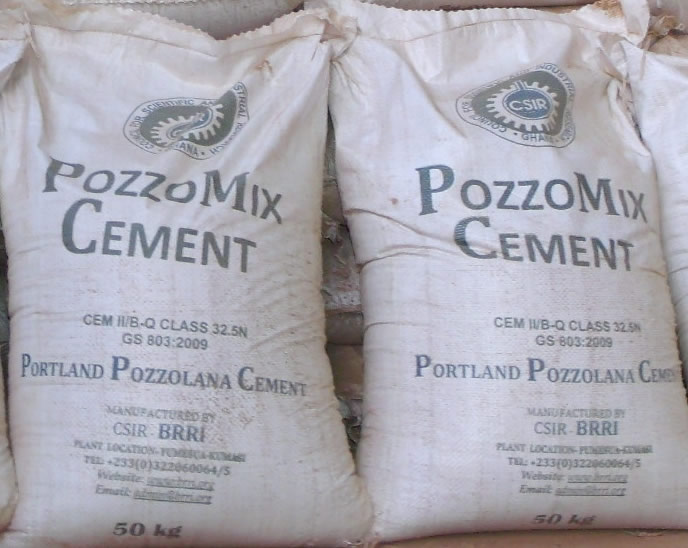
The Building and Road Research Institute (BRRI) of the Council for Scientific and Industrial Research has developed Pozzolana cement a cheaper, local alternative to Portland cement. The research is done. The institute is funded by the government. Yet no government housing project uses it.
Kwame Nkrumah University of Science and Technology (KNUST) has a compressed earth building on its campus built in 1973. More than 50 years later, it is still standing. Built with local soil and minimal cement. It was never replicated or scaled into policy.

The Ghana Real Estate Developers Association (GREDA) has publicly recommended laterite as a viable building material. Laterite is available everywhere in Ghana, literally under our feet. It has never featured in any government affordable housing specification.
While Government Waits, Ghanaians Are Already Building the Future
Private innovators are already doing what government refuses to do.
Makafui Awuku, founder of Mckingtorch Africa in Adenta, is manufacturing roofing sheets from recycled plastic waste — water sachets, plastic bags and packaging materials. He has already supplied over 200 school desks made from the same recycled material from a single workshop.
Nelplast Eco Ghana is converting plastic waste into pavement tiles and slabs that last over 35 years and are reported to be stronger than conventional concrete blocks — without cement or steel.
These are Ghanaian solutions, producing locally, creating jobs, and cleaning the environment. None of them has a supply partnership with the state housing programme.
Is Not A Funding Problem, It Is A Will Problem
The affordable housing crisis in Ghana is not a funding problem. It is not a technology problem. It is not even a materials problem.
It is a WILL problem.
The will to say we will not buy Portland cement at retail when BRRI has developed a local alternative. The will to say we will not import roofing sheets when a Ghanaian in Adenta is producing them from waste. The will to stop building 10,000 units at market price, calling it affordable, and then asking for more money.
Until that conversation is held honestly, every new affordable housing announcement will remain what it has always been a press release dressed as policy.
You can also read more on the real causes of dampness on your walls