
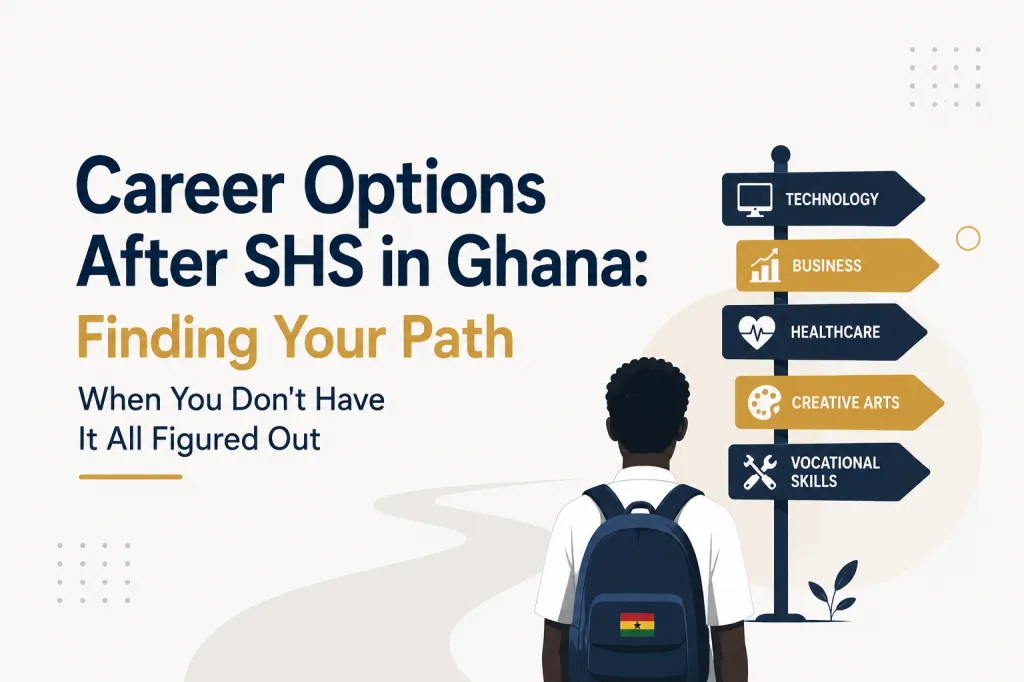
Career Options After SHS in Ghana: Finding Your Path When You Don’t Have It All Figured Out

Introduction
Every year, thousands of students graduate from Senior High School (SHS) in Ghana with one big question:
What’s next?
I understand this feeling because I have lived it.
Like many young Ghanaians, I thought life would become clearer after school. Instead, I found myself trying different paths, learning from mistakes, working different jobs, and gradually discovering where my strengths truly lie. Looking back, I now realize that not knowing everything immediately after SHS is not a failure—it is part of the journey.
This article is for every student who feels confused, pressured, or uncertain about the future.
There Is No Single Right Path
One of the biggest misconceptions young people have is believing everyone else has life figured out.
The truth is that many successful people changed careers several times before finding the right fit.
Some became entrepreneurs after university. Some left corporate jobs.
Some learned vocational skills before starting businesses.
Others discovered digital careers that did not even exist when they left school.
Your first decision does not have to be your final destination.
1. Continue to University
University remains an excellent option if your career requires professional qualifications.
Examples include:
- Medicine
- law
- Education
- Engineeeing
- Accounting
- Pharmacy
However, choosing university simply because everyone else is going is rarely a good reason. Your course should align with your interests, abilities, and long-term goals.
2. Choose TVET or Vocational Education
Technical and vocational education has become increasingly valuable in Ghana.
Skills such as:
- Plumbing
- Welding
- Carpentry
- Fashion Design
- Electrical installation
are high in demand.
Many skilled artisans today earn more than some university graduates because they provide services people need every day.
3. Learn Digital Skills
Technology has created opportunities that did not exist a decade ago.
Some digital careers include:
- Social media management
- Web design
- Data analytics
- Graphic designing
- Video editing
- Content writing
- Artificial intelligent
Many of these skills can be learned online, often at little or no cost, and they can open doors to remote work and freelancing.
Not everyone has to wait for employment.
Many successful businesses started with small ideas.
Examples include:
- Cleaning Services
- Food delivery
- Photography
- Agriculture
- Fashion
Starting small allows you to gain experience while building something of your own.
5. Apprenticeship
Learning directly from experienced professionals is still one of the fastest ways to acquire practical skills.
An apprenticeship teaches more than technical knowledge. It also develops discipline, customer service, and problem-solving.
6. Combine Learning and Working
Some people:
- Work during the day
- Study online at night
- Save money
- Build experience
- and later further their education
This combination can reduce financial pressure while helping you discover your interests.
My Journey of Discovering Myself
After SHS, I believed I needed to have my entire life planned.
Reality proved otherwise.
Over the years, I have explored different opportunities, questioned my direction, and sometimes felt uncertain about what career truly suited me. There were moments when I admired people who seemed to know exactly what they wanted while I was still searching.
Instead of seeing that uncertainty as failure, I eventually realized it was teaching me something valuable. Every experience introduced me to new skills, different ways of thinking, and a better understanding of what I enjoy and what I do not.
If you are currently in that season of searching, know that many people who are successful today once stood exactly where you are.
How to Choose the Right Career
Ask yourself:
- What activities do i genuinely enjoy?
- What problem do i like solving?
- What skills can i acquire?
- What careers are growing in Ghana?
- Can this careers provide me long term opportunities?
- Am i choosing this path because i want it or because others expect it?
The answers may not come immediately, but they will become clearer as you gain experience.
Final Thoughts
Life after SHS is not a race.
Some people will enter university immediately.
Some will learn a trade.
Some will start businesses.
Some will work while discovering themselves.
None of these paths is automatically better than the others. What matters most is your willingness to keep learning, improving, and taking purposeful steps forward.
If you do not have everything figured out today, do not lose hope. Your career is a journey, not a single decision. The experiences you gain, the skills you develop, and the resilience you build along the way will shape your future more than any one choice made immediately after SHS.