

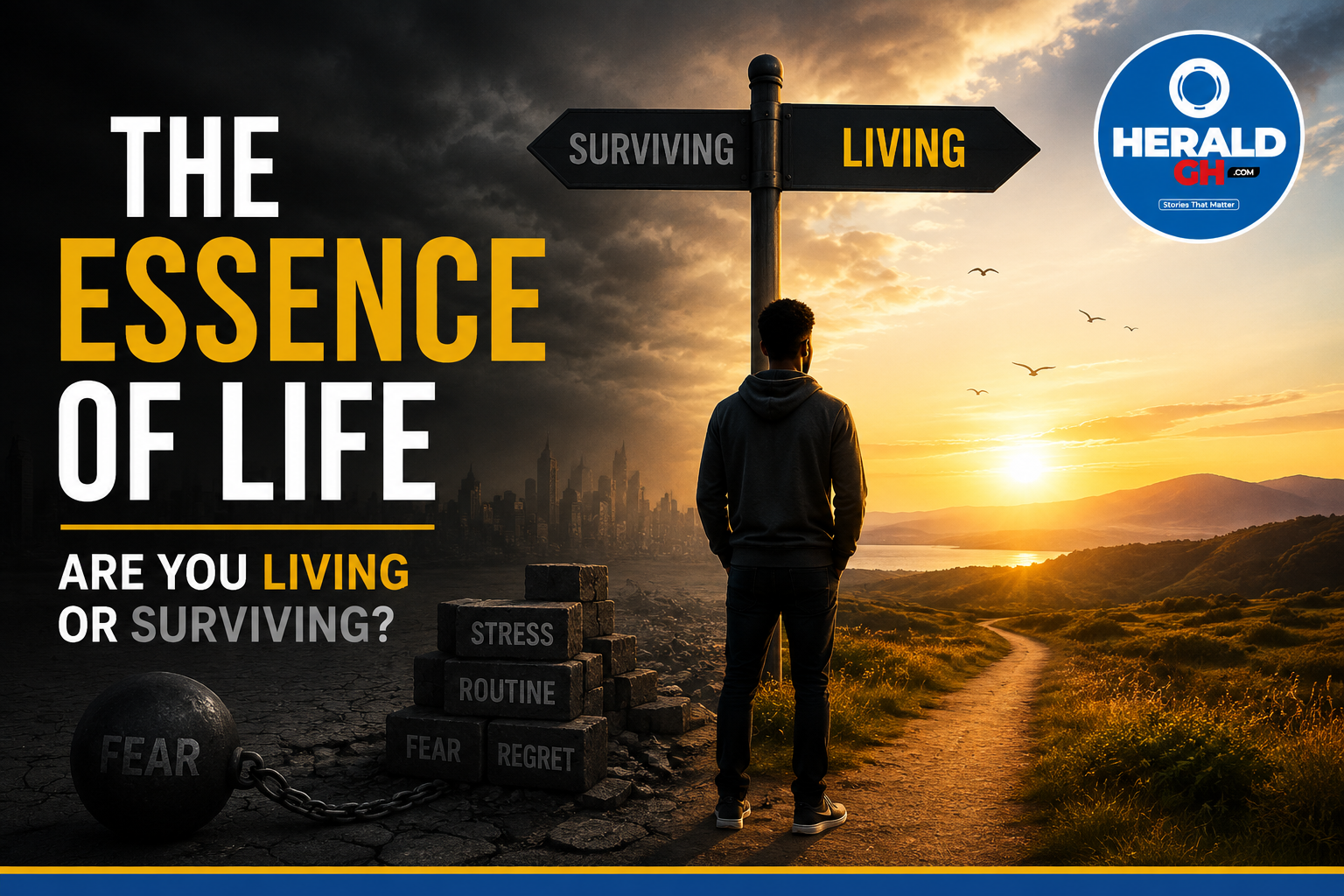
There is a strange thing about life.
We spend our childhood waiting to become adults. Then we become adults and spend our time waiting for the next salary, the next relationship, the next promotion, the next house, the next holiday or the next big opportunity.
We keep saying, “One day, when things get better, I will enjoy life.”
But what if that day never comes?
What if, somewhere between paying bills, chasing money, scrolling through social media, responding to messages and worrying about tomorrow, we forget to actually live today?
This brings us to one of humanity’s oldest questions:
What is the essence of life?
And perhaps an even more uncomfortable question:
Are we living or are we simply surviving?
Life Is More Than Staying Alive
Biologically, being alive is simple. Your heart beats. You breathe. Your brain functions. Your body continues operating.
But human beings have always understood that existence is more than biology.
A person can be alive and still feel as though they are not really living.
Think about someone who wakes up every morning, goes to work, comes home exhausted, eats, scrolls through their phone, sleeps and repeats the same routine the next day.
Nothing is necessarily wrong with that person.
They may even be financially successful.
But if their entire existence becomes a cycle of work, bills, sleep and repetition, something deeper begins to disappear.
The ancient Greeks had a useful distinction between merely being alive and living a meaningful life.
Aristotle believed that the good life was not simply about pleasure or survival. He spoke of eudaimonia, often translated as human flourishing a life in which a person develops their abilities, virtues and potential.
In simple Gen Z language:
Don’t just exist. Become.
You are not a phone battery whose only purpose is to stay at 1% until it eventually dies.
There is supposed to be something happening between birth and death.
The Story of Sisyphus
One of the most famous stories from Greek mythology is that of Sisyphus.
According to the myth, Sisyphus was condemned to push an enormous boulder up a mountain. Every time he nearly reached the top, the stone would roll back down.
So he had to start again.
And again.
And again.
Imagine doing the same thing forever.
No promotion.
No graduation.
No vacation.
No achievement.
Just the same mountain and the same stone.
Sounds exhausting, right?
Yet modern life can sometimes look surprisingly similar.
Wake up.
Work.
Eat.
Sleep.
Pay bills.
Repeat.
Monday.
Tuesday.
Wednesday.
Another month.
Another year.
Another birthday.
And suddenly you’re 40, 50 or 60 asking:
“Where did all the time go?”
The lesson isn’t that work is meaningless. Work is necessary. Responsibilities matter.
The question is whether your responsibilities have completely consumed your existence.
If everything you do is merely preparing for some future moment when you will finally begin living, you may eventually discover that you spent your entire life preparing for life.
The Lesson of Achilles
The ancient Greek hero Achilles provides another interesting way to think about life.
In Homer’s Iliad, Achilles faces a choice between living a long but relatively ordinary life or achieving extraordinary glory but dying young.
He chooses glory.
Whether we agree with his choice or not, the story reveals something important about human beings:
We don’t only want to live. We want our lives to mean something.
People want to be remembered.
They want to create.
They want to love deeply.
They want to make an impact.
They want to know that their existence mattered.
But there is a danger here too.
Modern society can turn the desire for significance into a competition.
You see someone your age buying a car.
Someone else is travelling.
Another person has started a business.
Someone is getting married.
Someone is becoming famous on TikTok.
Someone has 100,000 followers.
And suddenly your own life feels like a failure.
But Achilles’ story should not be interpreted as:
“Become famous before you die.”
Perhaps the better question is:
“What makes a life worth living to you?”
That answer will not be the same for everyone.
The Cave We Build for Ourselves
Plato’s famous Allegory of the Cave gives us another powerful lesson.
Imagine prisoners who have spent their entire lives chained inside a cave. They can only see shadows projected onto a wall.
Because they have never seen anything else, they believe the shadows are reality.
Then one prisoner escapes.
Outside the cave, he discovers an entirely different world.
When he returns to tell the others, they don’t necessarily celebrate him.
They resist him.
Why?
Because the truth is uncomfortable when you’ve become comfortable with an illusion.
Modern life has its own caves.
Sometimes the cave is social media.
Sometimes it is the pressure to look successful.
Sometimes it is society’s definition of happiness.
Sometimes it is a job you hate but are afraid to leave.
Sometimes it is a relationship that has already died emotionally.
Sometimes it is the belief that your worth is determined by money, appearance, followers or possessions.
We can become so accustomed to these things that we stop questioning them.
And perhaps one of the first steps toward truly living is asking:
“Are the things I am chasing actually mine, or did I simply learn to want them because everyone else wants them?”
The Stoics and the Reminder of Death
The ancient Stoics had a practice known as memento mori—a reminder that we will die.
At first, that sounds depressing.
But it was intended to do almost the opposite.
If you remember that your time is limited, you begin to value it.
You stop postponing every important conversation.
You stop assuming that the people you love will always be around.
You stop treating every problem as though it is the end of the world.
You realize that the argument you had yesterday may not matter ten years from now.
You begin to ask better questions.
What am I doing with my time?
Who am I becoming?
Who do I love?
What am I contributing?
What will remain when I am gone?
Death, ironically, can teach us how to live.
The Problem With “Making It”
For many young people today, life can feel like a race.
Get a degree.
Get a job.
Make money.
Buy a car.
Build a house.
Get married.
Have children.
Become successful.
Post the pictures.
Repeat.
There is nothing wrong with these things.
The problem begins when they become the entire definition of success.
Imagine finally getting the thing you spent ten years chasing, only to discover that you are still unhappy.
You buy the car.
Then you want a better car.
You get the job.
Then you want a better job.
You get the relationship.
Then you compare it with other people’s relationships online.
You reach one financial target.
Then another appears.
The finish line keeps moving.
This is why some people can have very little and still experience profound happiness, while others can have almost everything and still feel empty.
Possessions can improve the quality of your life, but they cannot automatically provide meaning to it.
So What Actually Matters?
Perhaps the essence of life can be found in a few simple things.
Love
Love makes us vulnerable.
It also makes life meaningful.
The love between parents and children. Friendship. Romantic love. The kindness of a stranger.
Years from now, you may not remember every amount of money you earned.
But you may remember the person who believed in you when nobody else did.
You may remember your mother’s voice.
Your father’s advice.
Your friend’s laughter.
The person who stayed when leaving would have been easier.
Human beings are not built only for achievement.
We are built for connection.
Growth
You are not supposed to remain the person you were five years ago.
Life changes us.
Failure teaches us.
Pain teaches us.
Experience teaches us.
The goal isn’t to avoid every difficult experience.
Sometimes the goal is to become wiser because we experienced it.
A meaningful life is not necessarily an easy life.
It is a life in which you continue becoming.
Contribution
One of the deepest forms of happiness comes from realizing that your existence is useful to someone beyond yourself.
Maybe you raise children.
Maybe you teach.
Maybe you build a business that employs people.
Maybe you create art.
Maybe you help a struggling friend.
Maybe you clean someone’s home.
Maybe you write something that changes someone’s thinking.
It doesn’t have to make the news.
Not every meaningful contribution becomes famous.
Some of the most important things human beings do will never receive applause.
Experience
There is a difference between having possessions and having experiences.
A house can be valuable.
A car can be useful.
Money can provide freedom.
But sitting under the evening sky with someone you love, laughing about something completely stupid, can become one of the memories you treasure most.
Life is made of moments.
And moments don’t announce themselves.
You don’t always know that you are living through a memory while it is happening.
Sometimes you only realize years later.
The Trap of Tomorrow
One of the greatest thieves of life is the word “later.”
I’ll call them later.
I’ll visit them later.
I’ll start later.
I’ll travel later.
I’ll apologize later.
I’ll rest later.
I’ll enjoy myself later.
I’ll pursue my dream later.
But later is not guaranteed.
This doesn’t mean you should abandon responsibility and spend every day chasing pleasure.
Quite the opposite.
It means you should stop sacrificing your entire present for an imaginary future.
Prepare for tomorrow.
But don’t completely abandon today.
Work for the future.
But don’t forget to experience the present.
Save money.
But occasionally enjoy some of what you worked for.
Build your career.
But remember that you are a human being, not just a résumé.
Are You Living or Surviving?
Perhaps the most important part of this entire conversation is self-examination.
Ask yourself honestly:
When was the last time you did something simply because it made you feel alive?
Not because it would make you money.
Not because it would impress people.
Not because it would increase your followers.
Not because society expected it.
Just because it mattered to you.
Ask yourself:
If money were not a problem, what would I spend more of my time doing?
If nobody could see my life on social media, would I still want the life I’m currently building?
Am I pursuing my dreams or someone else’s definition of success?
Do the people I love know that I love them?
Am I becoming the person I want to become?
If my life remained exactly as it is for the next ten years, would I be satisfied?
That last question can be particularly uncomfortable.
Because sometimes the answer reveals something we have been avoiding.
You Don’t Need to Have Everything Figured Out
Perhaps the essence of life isn’t about discovering one magical answer.
Maybe life is less like an examination with one correct answer and more like a journey where you gradually discover what matters.
You will make mistakes.
You will change careers.
You will lose people.
You will fall in love.
You will fall out of love.
You will fail.
You will succeed.
You will change your mind.
You will outgrow some people.
Some people will outgrow you.
That’s life.
The goal isn’t to control every part of it.
The goal is to participate in it.
The Question We Should All Ask
At the end of the day, perhaps the greatest tragedy isn’t dying.
It is reaching the end of your life and realizing that you were so busy trying to survive that you never gave yourself permission to live.
You worked.
You worried.
You compared.
You postponed.
You chased.
You accumulated.
But did you experience?
Did you love?
Did you grow?
Did you help?
Did you laugh?
Did you create?
Did you forgive?
Did you become yourself?
The essence of life may ultimately be found somewhere between existence and meaning.
We cannot control how long we will be here.
But, to some extent, we can influence what we do with the time we have.
So perhaps the question isn’t simply:
“How long will I live?”
Perhaps the more important question is:
“While I am alive, am I actually living?”
Because one day, whether we are ready or not, the story ends.
And when that day comes, perhaps the greatest thing we could hope for is not that we had the most money, the biggest house, the newest car or the most followers.
Perhaps it is simply that we can look back and say:
“I was here. I experienced this life. I loved people. I learned. I grew. I made mistakes. I contributed something. And I did not merely survive, I lived.”
